
How our Mutual Aid Pool Works
-
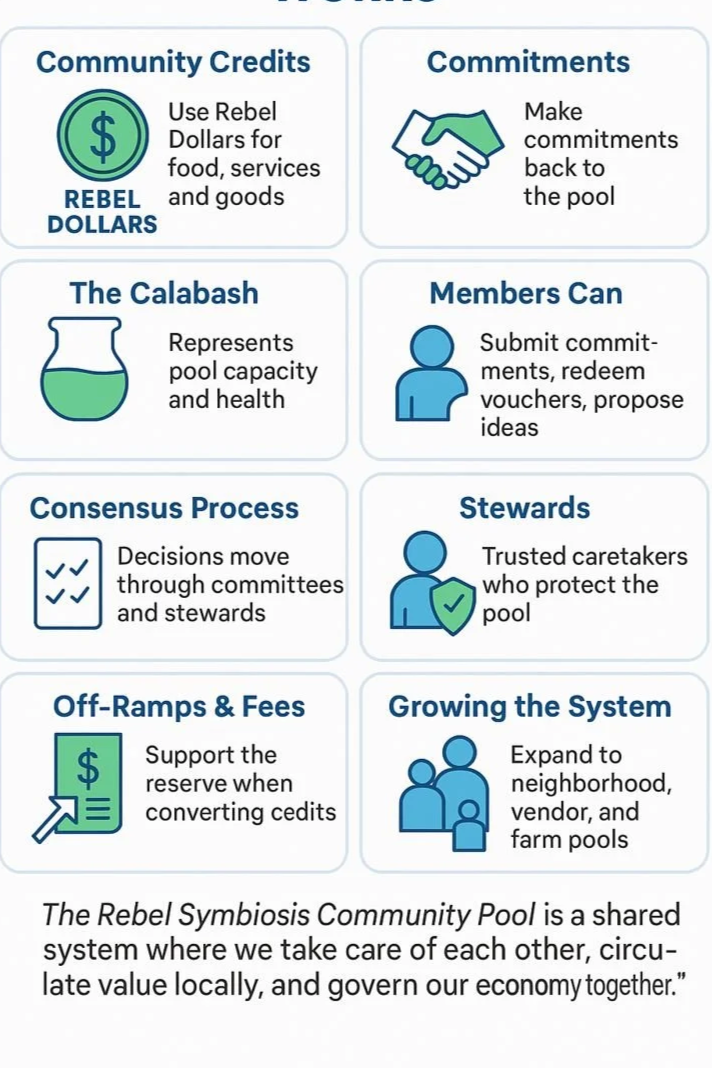
Community Credits (Rebel Dollars) are used to exchange value within the Pool.
They can be:
spent at participating vendors and farms
used for food, services, and goods
circulated multiple times within the community
Rebel Dollars are not cash and not a speculative currency.
They represent claims on real community goods and services. -
The Pool is built on reciprocity.
Whenever value is redeemed from the Pool, an equal-value commitment is issued back.
Commitments may include:
labor or volunteer hours
food or prepared meals
produce or seedlings
services or skills
other approved contributions
Commitments can be fulfilled immediately or scheduled for later.
This keeps the Pool balanced and sustainable. -
Content:
The Calabash represents the health and capacity of the Pool.It fills as members add commitments
It empties as value is redeemed
It helps prevent overuse and crisis
Example:
10 members × $80 capacity = $800 Pool
$400 seeded = 50% full
The Calabash helps the community see when to slow down, rebalance, or grow.
-
Content:
As a member, you can:redeem vouchers for food and services
use Rebel Dollars at participating vendors
submit personal commitments
view Pool health and your activity
propose ideas to improve the system
Members are both contributors and receivers — there are no beneficiaries.
-
Content:
The Pool is governed by consensus, not majority voting.Ideas move through:
Working Committees
Steward review
Community guidance
Consensus confirmation
Consensus means there are no strong, unresolved concerns — not that everyone agrees enthusiastically.
Anyone can bring forward an idea.
-
Stewards are trusted community members who:
maintain the ledger
convene balancing circles
support repair and mediation
document rule changes
Stewards:
do not own the Pool
cannot allocate resources at will
serve limited terms
can be removed if they stop serving the commons
Stewards exist to protect the system, not control it
-
Sometimes members or vendors may convert community credits back into regular currency.
When this happens:
a small fee may apply
fees go into a community reserve
the reserve protects Pool stability
These rules exist to:
prevent draining the system
encourage local circulation
support shared community assets (like the bodega)
-
As the community grows, the Pool may create:
vendor pools
farm production pools
youth or labor pools
neighborhood pools
Each new Pool follows the same principles and governance model and remains connected to the larger system.
Growth happens intentionally — not all at once.